
A client of mine in Lahore once sat across the table and told me his revenue hadn’t moved in three years. A competitor of his, selling almost the exact same amount, had just sold his company for ten times what my client expected to get for his own. He wasn’t thrilled. Honestly, I don’t blame him.
This kind of thing happens more than people think. Two companies can post identical revenue and still be worth wildly different amounts. Buyers rarely stop at the sales figure printed at the top of the page. They look underneath it. If you’ve ever wondered why that is, it’s exactly the sort of question a financial advisor lahore business owners go to tends to get asked, over and over. Valuation is almost never revenue multiplied by some tidy number.
So what actually explains it? And what can you do if your business falls on the wrong side of that gap?
Why Does Similar Revenue Doesn’t Mean Similar Value?
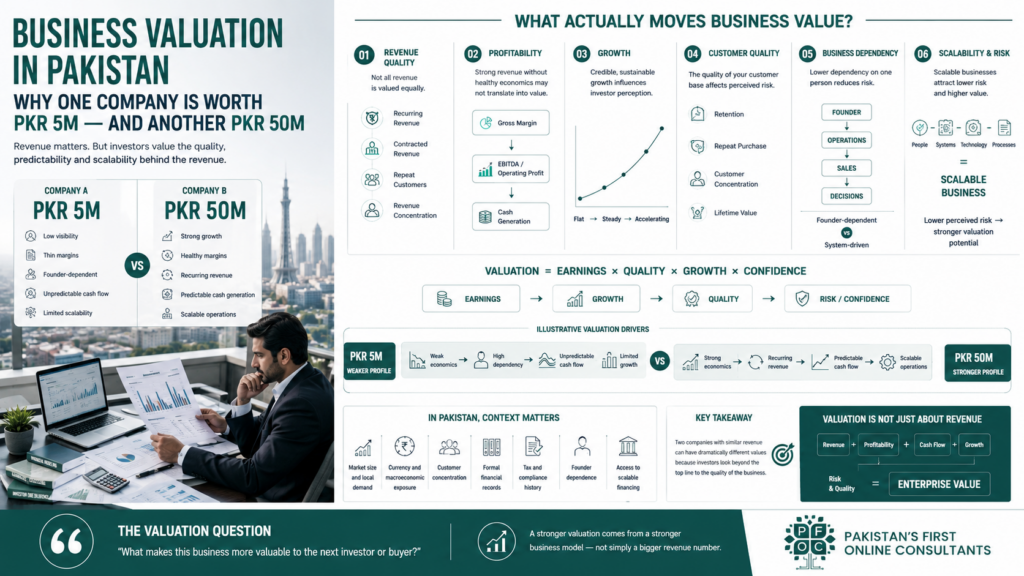
Take two companies. Both make PKR 40 million a year.
Company A depends heavily on one client for most of that revenue. Its bookkeeping is patchy at best. The owner signs off on nearly every decision himself. Margins swing depending on the month, sometimes wildly.
Company B looks different. A wide base of loyal customers. Clean records. Processes written down somewhere other than the owner’s head. A manager capable of keeping the business running even if the founder took a month off.
Same revenue. Two very different companies underneath.
Company B ends up worth more, almost every time. A buyer isn’t just handing over money for this year’s sales. They’re paying for confidence that next year looks roughly the same, ideally better.
What Actually Drives Business Value?
Here’s a rough way to think about it. Nothing fancy, no calculator required.
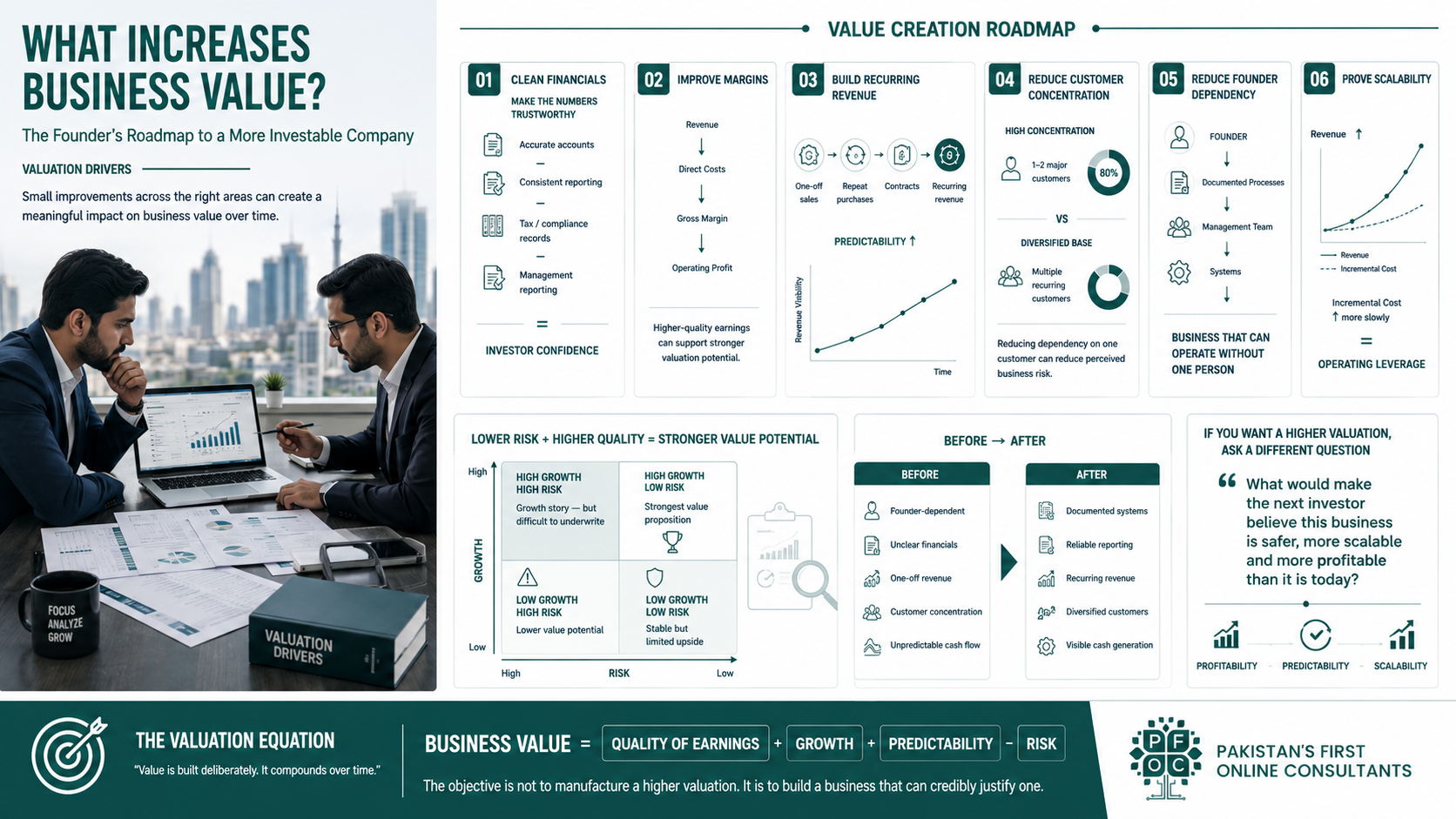
Value = Earnings + Growth + Quality + Predictability − Risk
Don’t treat that like an actual equation. It’s more of a checklist you run through in your head.
Earnings show what the business makes right now. Growth shows where things are trending. Quality is about whether those earnings are the kind that stick around, or the kind that vanish the moment something changes. Predictability is how confidently anyone, you included, can forecast next year. And risk sits underneath all of it, quietly chipping away.
Revenue Alone Doesn’t Set the Price
Does more revenue automatically mean more value? Not really, and this catches a lot of owners off guard.
Say a company earns PKR 20 million a year, and PKR 15 million of that comes from one customer. That’s a problem. Lose the client, and the business takes a serious hit. Buyers know this. They price the risk in, and often harder than owners expect.
What matters more than the total is the shape of it. Recurring or one-off? Spread across many customers, or riding on two or three? Climbing steadily, or bouncing around unpredictably from quarter to quarter?
Profit, Cash Flow, and the Numbers Behind the Numbers
Revenue minus expenses gets you to profit. But profit sitting in your accounting file isn’t the same thing as cash sitting in your bank account. Plenty of owners find that out the hard way.
A business can book a large sale today and not see a rupee of it for months. Rent still needs paying. Salaries still go out. Suppliers don’t wait around for that invoice to clear.
There’s a term for this worth knowing, even if you never formally get your business valued: maintainable earnings. It strips out one-off costs, owner perks, unusual bumps in income. Then it asks a fairly blunt question. What could this business realistically keep earning once somebody else is running it?
That number tends to matter far more to investors than whatever profit figure sits on your tax return.
Growth Needs an Engine, Not Just a Claim
Telling an investor you’ll double revenue next year and expecting a nod of approval rarely works. They want the mechanism behind that claim. A fuller sales pipeline. A new channel is opening up. Better conversion rates. More room to actually produce or deliver.
Growth with evidence behind it beats growth with hope behind it, every time, no exceptions.
Recurring Revenue and Customer Concentration
PKR 20 million from long-term contracts isn’t the same as PKR 20 million from a string of one-off jobs. Recurring revenue makes forecasting easier. It gives clearer visibility into cash flow. It tends to earn more trust from anyone looking to buy.
Now ask yourself honestly. How much of your income depends on one or two clients? Heavy concentration is one of the fastest ways to drag a valuation down, regardless of how healthy the top-line number looks sitting on its own.
Can the Business Run Without You?(Founder Dependency)
A lot of Pakistani SMEs quietly lose value here, often without the owner even clocking it. If every decision, every relationship, and all the know-how lives in one person’s head, the business isn’t really transferable. Not in any meaningful sense.
A buyer isn’t only paying for what exists today. They’re paying for the ability to keep it going tomorrow, without you standing there. Documented processes, an actual management layer, customer relationships that belong to the company rather than to you personally. All of it shifts the picture more than owners tend to realise.
Financial Records Matter More Than Owners Realise
Sloppy bookkeeping. Accounts that don’t reconcile. Personal spending tangled up with business spending. None of it looks good, and all of it plants doubt.
Doubt, in a buyer’s head, turns into risk pretty quickly. And risk, more often than not, shows up later as a lower offer on the table.
Pakistan-Specific Pressures
Local conditions shape valuation too, something generic advice tends to skip over entirely. Inflation squeezes margins and pushes salaries up. A weaker rupee hurts if you’re importing goods or paying for foreign software. Rising interest rates make borrowing more expensive. Slow-paying customers can quietly starve an otherwise healthy company of cash.
None of these pressures are unique to any one business. Ignoring them while working out what a company is worth is still a mistake, though, and a common one.
Choosing a Valuation Method
There’s no single correct way to do this. Asset-based valuation makes sense where assets carry most of the value. EBITDA multiples work when earnings are stable and there are similar companies to compare against. Discounted cash flow suits businesses with fairly predictable future cash, though small changes in assumptions can swing the result more than most people expect. Comparable company analysis sounds neat on paper. Finding a genuinely similar private Pakistani business to compare against, though, is rarely easy in practice.
The method matters less than the thinking that goes into picking it.
From PKR 5M to PKR 50M
| Factor | Lower-Value Profile | Higher-Value Profile |
| Revenue | Unpredictable | Recurring, growing |
| Customers | Concentrated | Diversified |
| Records | Weak | Reliable |
| Founder role | Essential | Transferable |
| Cash flow | Unstable | Predictable |
| Risk | High | Well-managed |
That gap between the two columns is rarely down to one dramatic factor. Usually it’s a pile-up of smaller ones, all pulling the number the same direction.
What You Can Do About It?
Start with your books. Clean them up, and keep personal expenses well away from business ones. Cut how much you rely on any single customer if you can manage it. Push toward recurring revenue through contracts or retainers instead of chasing one-off projects. Write your processes down somewhere other than your own head. Sort out any tax or legal loose ends before they become bargaining chips for whoever’s buying.
Frequently Asked Questions
How is a business valued in Pakistan?
Most valuations blend an earnings-based method, like an EBITDA multiple, with a look at assets, risk, and cash flow. Local factors like inflation, the rupee’s movement, and interest rates get folded in too. There isn’t one fixed formula. It depends on the business, and on why it’s being valued in the first place.
How much is my business actually worth?
Depends on your earnings quality, your growth story, and how much risk is sitting inside the business. Two companies with identical revenue can land on very different numbers once these get weighed in properly. A proper valuation looks at the full picture, not just what last year’s tax return shows.
Can a loss-making business still be valuable?
Yes, especially if it shows strong growth, a clear market opportunity, or valuable intellectual property. Investors sometimes pay for where a business is headed rather than where it currently sits. That growth story needs real evidence behind it, though, not just an optimistic pitch.
Does recurring revenue really increase valuation?
Usually, yes, mainly because it makes future performance easier to predict, and that builds buyer confidence. Contracts and retainers tend to be viewed more favourably than income from scattered one-off projects. It won’t guarantee a fixed premium on its own, but it does lower the perceived risk.
How does customer concentration affect my company’s value?
If one client accounts for most of your revenue, losing them could hit the business hard, sometimes fatally. Buyers treat that as a serious risk and often price it straight into a lower offer. Spreading your customer base out is one of the simplest ways to protect what your company is worth.
The Bottom Line
What separates a PKR 5 million business from a PKR 50 million one usually has nothing to do with revenue at all. It comes down to earnings quality, diversification, clean records, and a business that can keep running without its founder standing in the middle of everything.
PFOC(Pakistan’s First Online Consultants), works alongside owners on exactly this. Cleaning up the finances. Building a credible, defensible valuation story before anyone else gets a look at the business.
If you’re gearing up to sell, or thinking about raising investment, working with an experienced financial advisor lahore entrepreneurs can stop you from underselling something you’ve spent years building.
Business value was never really a number pulled from last year’s accounts. It’s a measure of how confidently someone else can expect your business to keep performing once you’ve handed over the keys.